Paros Transport Guide
How to Get Around Paros
Car rental, bus, taxi, ATV, or walking, each option has a clear best use case. Here is exactly what to use for each part of your trip.
Quick Comparison
| Option | Cost / day | Flexibility | Best for |
|---|---|---|---|
| Car rental | €40–€90 | Highest | Beach hopping, mountain villages |
| ATV / Scooter | €20–€35 | High (flat roads) | Coastal routes; avoid mountains |
| Bus | €2–€5 | Low | Parikia ↔ Naoussa, Lefkes, Pounda |
| Taxi | €12–€25 per trip | Medium (if available) | Arrivals, early departures |
| Walking | Free | Within villages | Old towns, coastal paths, hiking |
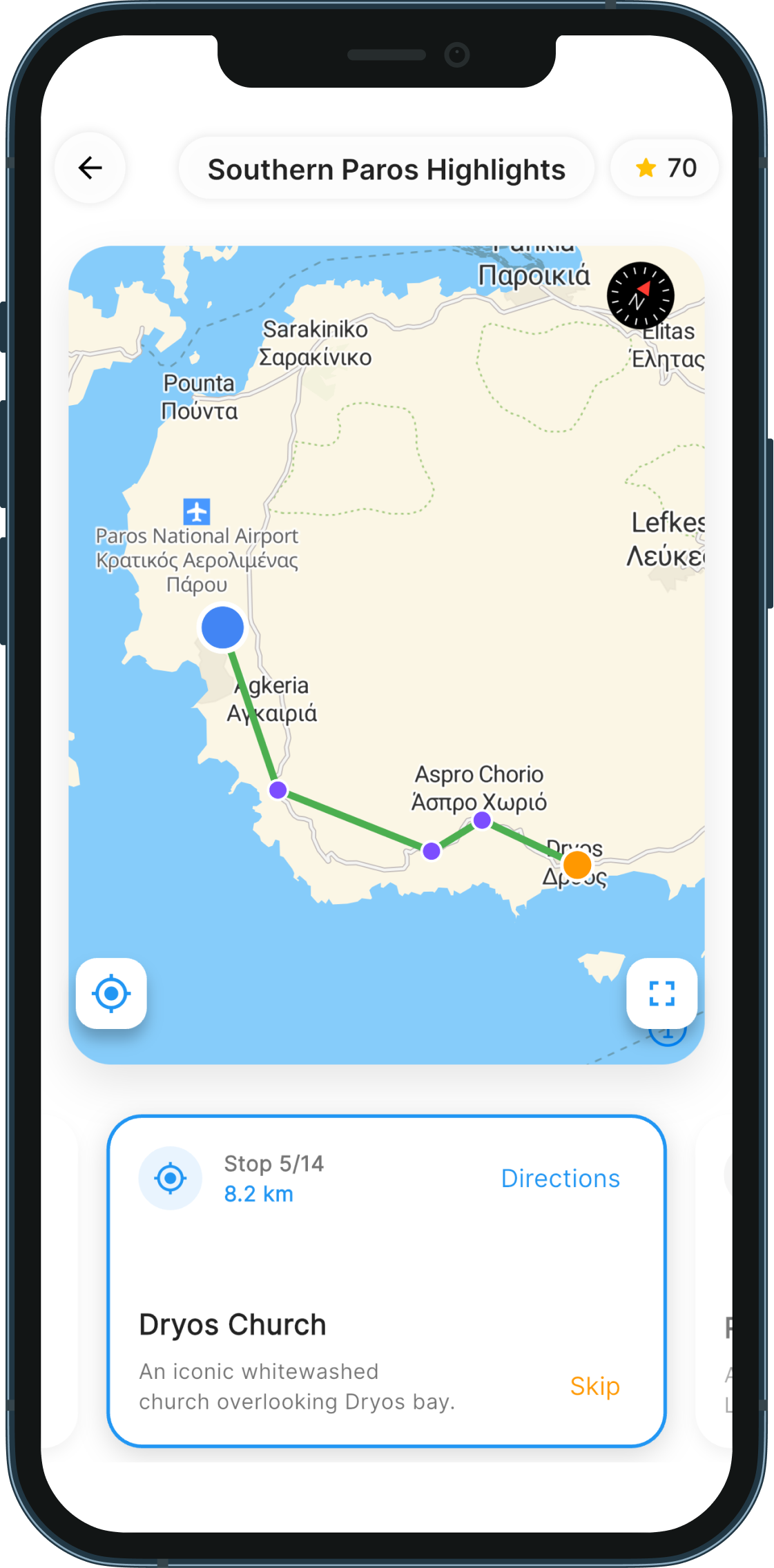
Skip the planning — follow a route
Routey self-guided tours pair a curated driving or walking route with stop narratives and riddles, so you always know where to go and what you are looking at when you arrive.
Do You Need a Car in Paros?
The short answer: no, you do not need a car in Paros, but most visitors should rent one for at least a day or two. If you are staying in Parikia or Naoussa and are happy with the towns plus one or two main beaches, the summer bus network covers you. The moment you want the south-coast beaches, the mountain villages beyond Lefkes, or more than two stops in a day, a car stops being a luxury and becomes the difference between seeing Paros and seeing a corner of it.
Staying in Parikia or Naoussa, 2–3 days
No car needed
Both towns are fully walkable and connected to each other by an hourly summer bus. Add one taxi or bus ride to a main beach and you have covered the essentials without ever touching a steering wheel.
Beach hopping / exploring the whole island
Rent a car
The south-coast beaches (Faraggas, Aliki), the east coast, and viewpoints between villages are either unreachable by bus or served only 2–3 times a day. A car turns a 2-beach trip into a 5-beach trip.
Families with young children
Rent a car
Buses are standing-room-only at peak times and the walk from some bus stops to the sand is longer than it looks on a map. A car with air conditioning and a boot full of beach gear removes all friction.
Budget travelers
Bus + 1–2 rental days
Use the KTEL bus for Parikia–Naoussa–Lefkes and the Golden Beach line, then rent a car for one or two days to cover the south coast and the interior. Roughly €50–€120 total transport for a 5-day trip.
Deciding what to do with those car days? Start with the mountain villages and the south-coast beaches, the two things the bus network handles worst.
Car Rental
Recommended for most visitorsPros
- Reach every beach and village on the island
- No schedule constraints
- Park anywhere
- Best value for 2+ people
Cons
- Mountain roads are narrow and steep
- Parking in Parikia old town is limited
- Not needed if you are staying in Parikia and not venturing far
Typical cost: €40–€60/day shoulder season, €65–€90/day in July–August
Book through local agencies in Parikia, significantly cheaper than international brokers and no deposit surprises.
A small hatchback (Citroën C1, Hyundai i10) handles all paved roads. You do not need a 4WD.
The road from Parikia to Lefkes is steep and narrow in places. Take it slowly.
Book at least 3–5 days ahead in peak summer, cars sell out.
ATV & Scooter
Fun, but requires carePros
- Cheaper than a car (€20–€35/day shoulder season)
- Easy parking everywhere
- Fun on flat coastal roads
Cons
- Mountain roads are genuinely dangerous
- Gravel and sand on road surfaces
- Fatal accidents on Greek islands involving scooters are not rare
- No shelter from sun or rain
- A standard car license is not enough for most scooters
Typical cost: €20–€35/day for an ATV and €18–€30/day for a scooter in shoulder season; expect €35–€55/day for ATVs and €25–€40/day for scooters in July–August.
License check, this catches people out every summer: a standard car (category B) license does not cover scooters of 50cc and above in Greece. You need an actual motorcycle license (A1 or A category) for scooters, and reputable agencies will refuse to rent without one. Rules for ATVs/quads are treated differently by rental agencies, some accept a car license for larger quads, so confirm with the rental agent and your travel insurance before you pay.
Always wear a helmet, it is legally required and the road surface quality on mountain roads varies.
Avoid the Lefkes mountain road on a scooter. It is steep, narrow, and has loose gravel sections.
Do not drive at night on unfamiliar roads. Visibility is poor and the road markings are minimal.
Check the brakes carefully before you drive away, rental ATVs are often older vehicles.
ATVs feel stable but are top-heavy on cambered bends, take corners much slower than feels necessary. They are also slow: budget nearly double the car driving times for cross-island trips.
KTEL Bus
Works for main routes; limited for beach hoppingThe island bus network is run by KTEL Paros, and Parikia is the hub, virtually every line starts and ends at the bus station directly outside the ferry port. The three main lines are: Parikia–Naoussa (the workhorse route, most frequent), Parikia–Lefkes–Marpissa–Piso Livadi–Golden Beach (the cross-island line that serves the mountain villages and the east-coast beaches), and Parikia–Pounda–Aliki via the airport (the southwest line, also your bus to the Antiparos ferry). In July and August the Naoussa line runs roughly every 30–60 minutes and the other lines several times a day; in shoulder season (April–May, October) frequencies drop sharply and some runs disappear entirely, always check the current KTEL Paros timetable rather than assuming last year's schedule.
Pros
- Very cheap (roughly €2–€3.50 per journey depending on distance)
- Parikia hub connects Naoussa, Lefkes, Piso Livadi, Golden Beach, Pounda, and Aliki
- No parking stress
- Naoussa line is genuinely frequent in summer
Cons
- Evening service is thin, last buses back to Parikia are typically mid-to-late evening even in summer
- Very limited on weekends and in shoulder season
- Remote beaches (Faraggas, Agios Fokas, Lageri) are not served at all
- Buses fill to standing room at peak beach hours
Typical cost: Roughly €2–€3.50 per journey depending on distance. No day pass available.
| Route | Duration | Fare | Frequency |
|---|---|---|---|
| Parikia → Naoussa | 20 min | ~€2 | Every 30–60 min in peak summer |
| Parikia → Lefkes | 30 min | ~€2 | Several per day (cross-island line) |
| Parikia → Piso Livadi / Golden Beach | 45–55 min | €2.50–€3.50 | Several per day in summer |
| Parikia → Pounda (Antiparos ferry) | 20 min | ~€2 | 6–8 per day in summer |
| Parikia → Aliki / airport | 30 min | €2–€2.50 | Several per day |
| Naoussa → Santa Maria / Kolympithres | 10–15 min | ~€2 | Seasonal beach shuttle, summer only |
The bus station is directly outside the Parikia ferry port, you cannot miss it. A secondary hub in Naoussa serves the seasonal beach shuttles toward Santa Maria and Kolympithres.
Where to buy tickets: at the KTEL station in Parikia, from kiosks and mini-markets near major stops, or on board from the conductor (cash is the safe assumption, do not rely on card acceptance).
Check the current schedule on the KTEL Paros website or at the station before planning your day around a bus. Timetables change between months, not just between seasons, and printed timetables at the tourist office go out of date.
The honest limitation: buses get you to a beach for the day, they do not do beach-hopping. One beach per day by bus is realistic; three beaches in a day needs a car.
For an evening in Naoussa without a car, confirm the time of the last bus back before you go, and treat the timetable's last departure as optimistic. A taxi backup plan (booked, not hoped for) is wise in August.
Taxi
Use for arrivals/departures; scarce for on-demand useParos has a genuinely small taxi fleet, a few dozen licensed cars for the whole island, and no ride-hailing apps like Uber operate here. In May or October that fleet is enough; in August it is nowhere near demand, and an unbooked taxi at a beach at 6pm is close to fantasy. The rule is simple: taxis on Paros are something you book, not something you find.
Pros
- Door to door
- Fixed rates to main destinations
- Available at the ferry port on arrival
Cons
- Very small fleet, a few dozen taxis for the whole island
- Almost impossible to find one on demand in peak summer
- Cannot be hailed on the street, must be booked
- In August, book important trips a day ahead
Typical cost: Rough ranges: Parikia → Naoussa €15–€20. Parikia → Lefkes €12–€18. Parikia → airport or south-coast beaches €18–€25. Confirm the fare before you get in.
Book in advance for early ferry or flight departures, in August, do it the evening before at the latest. Your accommodation can arrange this for you.
The Paros Taxi app is available for booking, more reliable than calling in peak season.
Fixed rates to the main destinations are set locally and posted at the Parikia rank. Confirm the fare before you get in.
Taxis outside the Parikia port at arrival time are fine, they meet the ferries. Do not expect to find one randomly during the day.
If a taxi is your plan for getting back from a beach or a dinner in Naoussa, book the return leg at the same time as the outbound one.
Walking
Essential within Parikia and Naoussa; limited for inter-village travelPros
- Free
- Best way to see Parikia Old Town and Naoussa harbor
- Some coastal paths are genuinely beautiful
Cons
- Distances between villages are too large to walk in heat
- No shade on main roads
- Hills are steep inland
Typical cost: Free
Walk Parikia Old Town, it is the only way to experience the narrow lanes properly. No car fits.
The coastal path from Parikia around the bay to Krios and Marcello beaches (roughly 40 min each way) is one of the best easy walks on the island, or take the summer taxi boat one way.
The Byzantine Path from Lefkes to Prodromos (5km, 2–3 hours) is the best inland walk. Marble-paved, well-marked.
Walk in the early morning or late afternoon. The midday sun between June and September is genuinely dangerous for long walks.
How Long Does It Take to Drive Across Paros?
Paros is small, about 21 km north to south, and nothing on the island is more than roughly 40 minutes' drive from Parikia. A full loop of the coastal road takes around 1.5–2 hours of pure driving time without stops, which is why a one-day car rental genuinely covers the whole island. The figures below are practical approximations for normal summer traffic; add 10–15 minutes for August congestion around Parikia and Naoussa.
Quick facts: typical driving times
First, Getting to Paros
This page covers transport on the island. If you are still planning how to reach Paros in the first place: most visitors arrive by ferry into Parikia port, 3–5 hours from Athens (Piraeus) or a short hop from Naxos, Mykonos, or Santorini, while a small airport in the southwest (PAS) handles domestic flights from Athens. We cover every route in dedicated guides:
How to Get to Paros
Every route compared: ferries vs flights
Athens to Paros Ferry
Piraeus departures, 3–5h, operators & fares
Mykonos to Paros Ferry
Under an hour on fast ferries
Santorini to Paros Ferry
Island-hopping the classic route
Naxos to Paros Ferry
The shortest hop in the Cyclades
Flights to Paros
Paros airport (PAS), routes & transfers
Follow a Route, Not Just a Map
Routey self-guided tours combine a curated driving or walking route with stop narratives and riddles, so you know exactly where to go and what you are looking at when you get there.
Frequently Asked Questions
Do you need a car in Paros?
No, you do not strictly need a car in Paros, but most visitors are glad they rented one for at least part of their stay. The bus covers Parikia, Naoussa, Lefkes, the Golden Beach line, and Pounda adequately in summer; a car is what unlocks the south-coast beaches, the east coast, and seeing more than one or two places per day. For a 3+ day trip, renting a car for 2 of those days is the sweet spot.
Can you get around Paros without a car?
Yes, comfortably, if you base yourself in Parikia or Naoussa. The two towns are connected by a frequent summer bus (roughly every 30–60 minutes), the KTEL network reaches Lefkes, Piso Livadi, Golden Beach, Pounda, and Aliki, and both old towns are entirely walkable. What you give up without a car: remote beaches like Faraggas and Lageri, evening flexibility (buses thin out at night), and the ability to visit several beaches in one day.
How do I get from the Paros ferry to my hotel?
If your hotel is in Parikia, it is walkable from the ferry dock, most hotels are within 15 minutes on foot and will store luggage if you arrive early. For Naoussa, a taxi is easiest (€15–€20, 20 min) or the bus from outside the port (~€2, 20 min). For south-coast accommodation, taxi or pre-arranged rental car pickup at the port.
Is there Uber in Paros?
No. Uber does not operate in Paros, and neither do other international ride-hailing apps. The island has local licensed taxis only, a small fleet of a few dozen cars. The Paros Taxi app (iOS and Android) is the local booking equivalent, but in peak summer even the app is not guaranteed to find you a car quickly. Book in advance for important journeys like ferry and flight connections.
How much is the bus from Parikia to Naoussa?
Around €2 each way, exact fares change slightly year to year, so treat €2–€2.50 as the realistic range. The journey takes about 20 minutes and runs roughly every 30–60 minutes in peak summer, less often in shoulder season. Buy tickets at the KTEL station in Parikia, at kiosks near the stops, or on board with cash.
How much does it cost to get around Paros?
Budget approximately €15–€30 per day for transport if you use a mix of car rental and bus. A car for 2 days (€80–€120 total in shoulder season) plus buses for the rest is a reasonable approach for a 5-day trip. Taxis are expensive for the distances, use them only for the ferry or airport connection.
Is it safe to drive in Paros?
Yes, with care. The main roads between Parikia, Naoussa, and the coast are well-paved and clearly marked. Mountain roads to Lefkes and the interior villages are narrow, steep, and sometimes have loose gravel on bends. Drive slowly, give way on narrow sections, and do not attempt mountain roads on a scooter unless you are experienced. Do not drive at night on unfamiliar roads.